
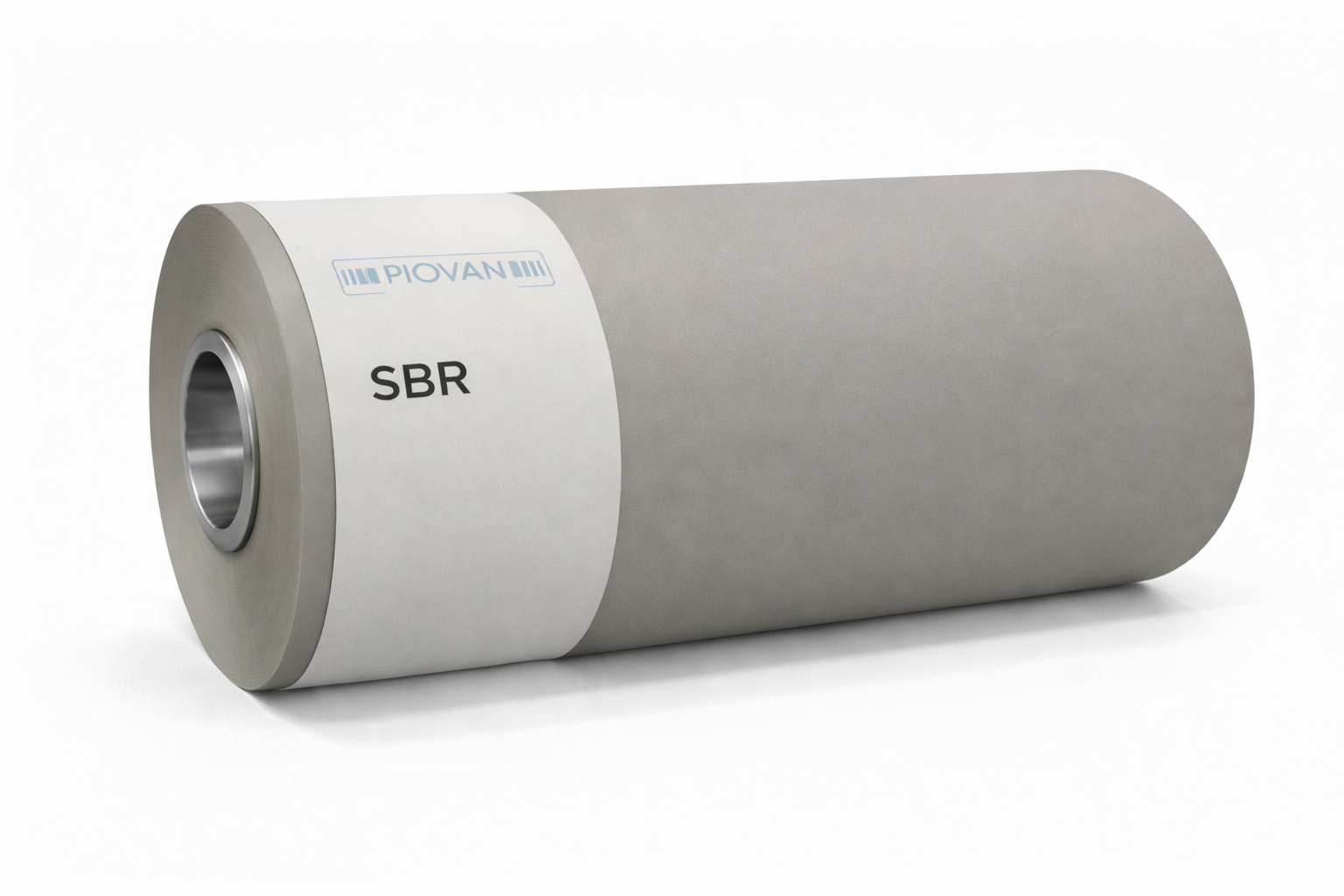
SBR (Styrene Butadiene Rubber)
If we want to highlight the technical peculiarities and strategic value of SBR rubber we can consider:
- Efficiency : SBR represents the gold standard for those seeking the best possible balance between mechanical performance and cost-effectiveness on a large scale.
- Champion in Wear Resistance : The real strength of SBR lies in its exceptional abrasion resistance, which makes it superior to natural rubber in all dynamic applications subject to continuous rubbing, such as in the production of tires, shoe soles and industrial conveyor belts.
- Stability and Reliability over Time : Thanks to its particular chemical structure, this material offers superior resistance to thermal aging and oxidation compared to many general- purpose elastomers , ensuring components that maintain their functional characteristics even after prolonged use.
- Formulation Versatility : The nature of SBR allows for extraordinary flexibility in compounds; whether produced in emulsion (E-SBR) for maximum workability or in solution (S-SBR) for ultra-high performance , this material adapts with millimetric precision to the specific needs of each industrial project.
General Features
The performance of the SBR is as follows:
Working temperature: typically ranges from -50°C to +100°C, with peaks of +120°C; the lower limit is dictated by the styrene content, while above 100°C, thermal stabilizers are required.
Hardness range: As standard it varies between 40 and 80 Shore A, extendable to 90 Shore A for special compounds.
Abrasion resistance: excellent and superior to that of natural rubber at the same hardness, making SBR the material of choice for surfaces subject to trampling or rolling.
Tensile strength: It is usually between 15 and 20 MPa (total range 10-25 MPa ), a value strongly influenced by the type of reinforcement, such as carbon black or silica.
Compression set : considered good or moderate (25–45% at 70°C/22h), showing better performance than natural rubber at high temperatures.
Resilience : Resilience (50-70% at 23°C) is lower than natural rubber but perfectly adequate for most standard dynamic applications.
Air/Oxygen: Under room temperature conditions, antioxidant-protected SBR offers good oxidation resistance, surpassing natural rubber. Above 80°C, resistance becomes moderate as oxidation accelerates, requiring the use of phenolic or amine antioxidants. For prolonged heat aging above 100°C, resistance drops to moderate/poor due to progressive stiffening of the material.
Photooxidative Agents : Direct sunlight offers moderate resistance, with the risk of surface cracking over time. However, the protection provided by carbon black or the addition of paraffin waxes and UV absorbers brings resistance to a good level, sufficient for many outdoor applications. In the absence of UV radiation (indoor environments), performance is excellent.
Ozone: SBR exhibits moderate resistance to ozone at ambient concentrations (0.01–0.05 ppm), making it less sensitive than natural rubber. However, at high industrial concentrations (>0.1 ppm), resistance is poor and the risk of premature failure is high. The use of specific additives (p-PPD, 6PPD) and waxes ensures good protection, but for outdoor applications under critical mechanical stress, EPDM remains the preferred alternative.
Solvents: Resistance to aliphatic (n-hexane) and aromatic (toluene, xylene) hydrocarbons is poor, resulting in significant swelling or dissolution. Chlorinated solvents also attack the material rapidly. Conversely, moderate to good resistance is found to polar solvents (acetone, MEK) and very good resistance to alcohols (methanol, ethanol), making SBR suitable for occasional contact with these substances.
Petroleum, Fuels, and Hydrocarbons: SBR is not recommended for almost all applications in petroleum environments. Resistance to mineral oils, hydraulic oils, diesel, and gasoline (including biofuels) is poor, leading to a complete loss of mechanical properties. Resistance to vegetable oils is only moderate, while performance is good with water-based greases and lubricants.
Water and Other Chemicals: The material excels in contact with water at room temperature and maintains good resistance up to 60-80°C, but is less suitable for steam above 100°C. Resistance to diluted bases, saline solutions (sea water), and detergents/soaps is good to excellent. SBR is also compatible with glycols (antifreeze) and diluted alcohol solutions. Resistance to acids is moderate when diluted and poor when concentrated.
Want to learn more about other tires? Click here.
Would you download the document?
You might be interested
Request a quotation
id prod->8236
nome prod->SBR (Styrene Butadiene Rubber)
id prod->8236
nome prod->SBR (Styrene Butadiene Rubber)