
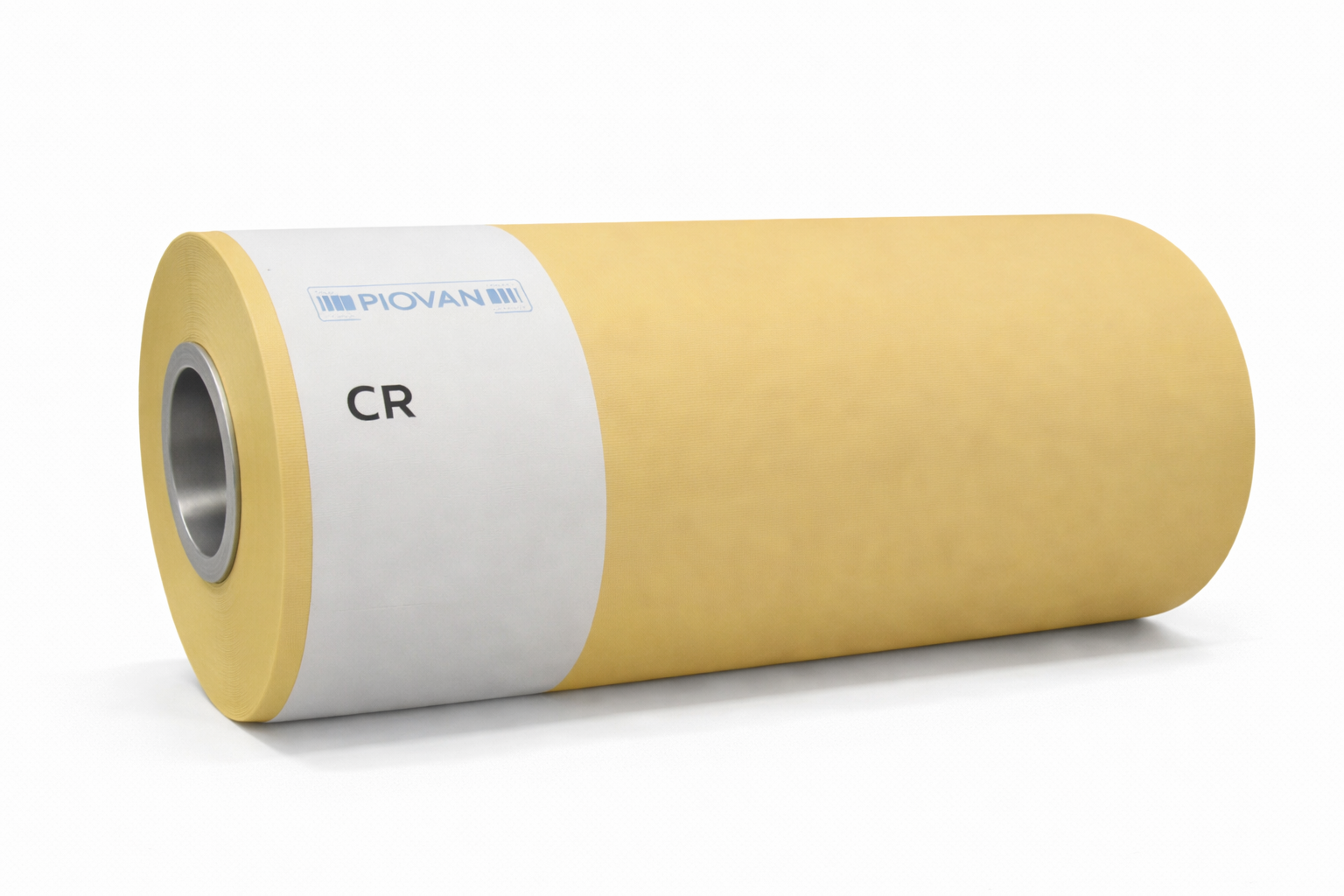
CR (Chloroprene Rubber)
CR is a material often used for the production of rubber-coated industrial cylinders due to its:
- Ability to adapt to situations and mitigate excesses: In industrial cylinders operating under variable or unpredictable conditions, CR stands out as a “premium general-purpose” elastomer capable of ensuring high performance across all critical parameters simultaneously.
- Consistent performance under multiple and combined stresses: CR rubber-coated cylinders excel in harsh industrial environments thanks to their unique ability to simultaneously withstand atmospheric agents, contact with oils, cyclic mechanical stress, and temperature changes.
- Intrinsic safety for hazardous environments: CR rubber-coated cylinders are ideally suited to safety-critical sectors such as mining and automotive, where flame resistance is a must. Added to this are excellent mechanical properties comparable to natural rubber, which ensure the cylinder’s structural strength and ability to absorb shock and vibration without deteriorating the lining.
- Coating longevity on systems exposed to the elements: For industrial cylinders installed outdoors or in environments with high ozone and UV radiation, CR guarantees a coating life of more than 20 years, reducing maintenance costs and increasing operational continuity
General Features
CR performance varies depending on the type of polychloroprene used (such as general purpose G- type ) and the vulcanization system.
Working temperature : the material covers a very wide range, from -40 °C to +100 °C with peaks of +120 °C, resulting superior to NBR for the lower limit.
Hardness range: Hardness is widely adjustable, with a typical industrial range of 40 to 80 Shore A.
Abrasion resistance: It is rated good to excellent, surpassing both NBR and EPDM and making it suitable for severe mechanical applications.
Tensile strength: it is high, typically between 18 and 22 MPa ,
Tear resistance: reaches very high values (80-150 kN/m), comparable to natural rubber.
Compression set: Neoprene offers good performance (20–35% at 70°C/22h), superior to NBR and comparable to EPDM.
Resilience: It remains at good levels (50-70%), making it suitable for dynamic applications.
Flame resistance : This is excellent and essential for industries such as mining and automotive safety. Finally, the material boasts exceptional adhesion to fabrics and metals, making it ideal for structural adhesives and laminates.
Resistance to Air and Oxygen: Aging in air at room temperature is considered excellent, with stability far superior to that of natural rubber. Even at high temperatures (80-100°C), thermal stability remains good to excellent, surpassing NBR in terms of oxidative aging. Resistance remains good for prolonged exposure above 100°C.
Resistance to UV light and photooxidative agents : Neoprene’s resistance to UV rays is excellent: it can last for more than 20 years under direct sunlight. Even without specific protection, prolonged exposure may cause only slight surface yellowing without compromising mechanical properties. The use of carbon black further enhances this intrinsic resistance, making it a standard for critical outdoor applications.
Ozone Resistance: Neoprene is virtually immune to atmospheric ozone (0.01–0.05 ppm), showing no cracking even after prolonged exposure. Resistance remains excellent even at high industrial concentrations (>0.1 ppm) or in the presence of electric motors, without the need for specific protective additives. In this respect, it is comparable to EPDM and superior to all diene elastomers such as NR or NBR.
Solvent Resistance: Behavior toward aliphatic hydrocarbons (n-hexane) is moderate, with limited swelling, making it suitable for occasional contact. Resistance to aromatic hydrocarbons (toluene) is moderate to poor, making it unsuitable for prolonged immersion. The material is incompatible with chlorinated solvents, but offers fair resistance to polar solvents (acetone) and excellent resistance to alcohols (methanol, ethanol).
Resistance to petroleum, fuels, and hydrocarbons: Neoprene exhibits moderate to good resistance to mineral oils and hydraulic oils, with limited swelling (30-50%), making it suitable for intermittent contact. Resistance to diesel fuels and gasoline is moderate and acceptable only for limited exposures. Conversely, resistance to vegetable oils, animal fats, and industrial lubricating greases is very good.
Resistance to water and other chemicals : Neoprene boasts an extremely low water absorption rate, allowing it to maintain its dimensions and elasticity even after prolonged immersion. It is particularly effective against salt corrosion. It exhibits excellent resistance to diluted acids, bases, and saline solutions, maintaining its structural integrity. It also has reasonable resistance to mineral oils and vegetable fats.
Want to learn more about other tires? Click here.
You might be interested
Request a quotation
id prod->8239
nome prod->CR (Chloroprene Rubber)
id prod->8239
nome prod->CR (Chloroprene Rubber)