
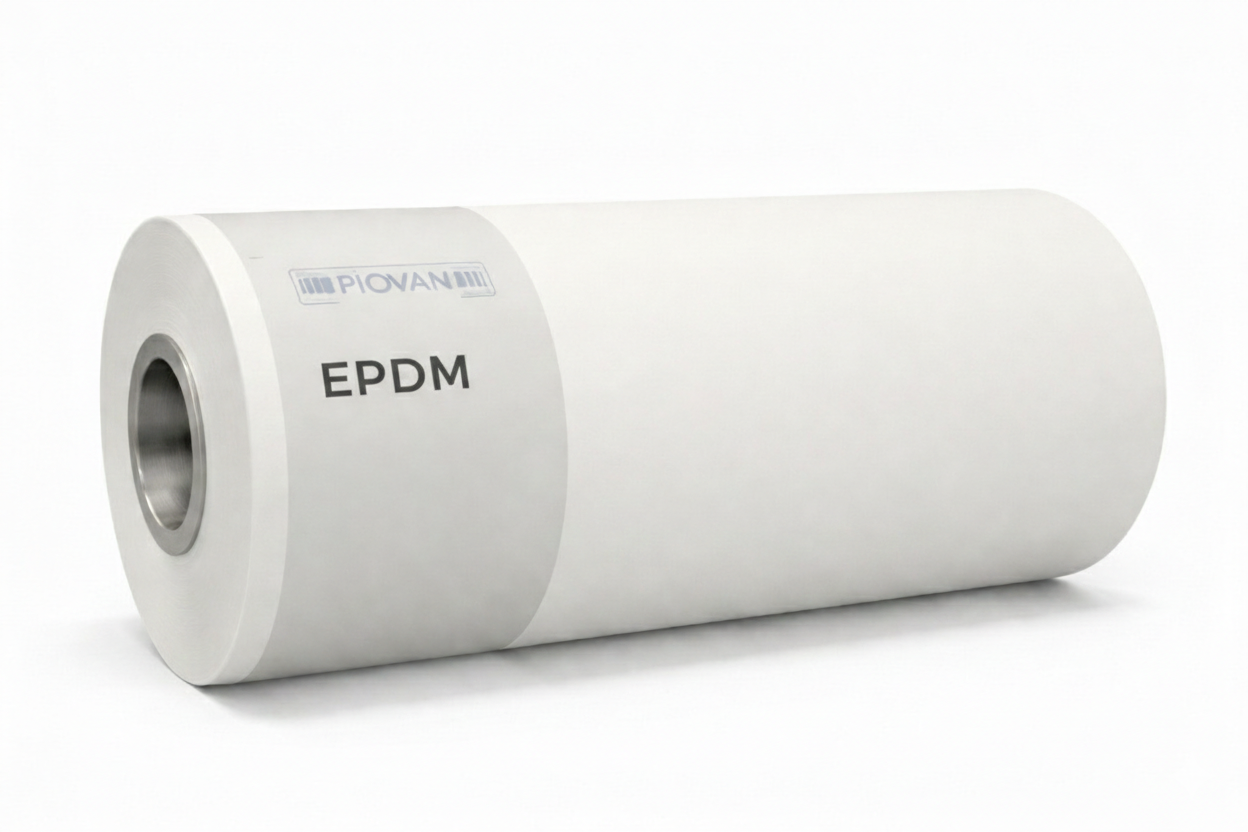
EPDM (Ethylene Propylene Diene Monomer)
The EPDM is a widely used material for rubber-coated industrial cylinders due to its:
- Superior durability in harsh industrial environments: In rubber-coated cylinders exposed to the outdoors or in aggressive environments, EPDM guarantees a service life exceeding 20-30 years. Its saturated molecular structure makes it virtually immune to ozone, UV rays, and atmospheric oxygen.
- Thermal and chemical stability for heavy-duty applications: The EPDM lining of industrial cylinders maintains its mechanical and adhesion characteristics over a wide temperature range, from -45°C to +150°C. Its excellent resistance to hot water, steam, saline solutions, and phosphate ester-based hydraulic fluids makes it the standard in industries where cylinders operate in contact with aggressive fluids.
- Electrical insulation integrated into the lining: The high intrinsic dielectric properties of EPDM provide reliable insulation without the need for additional treatments, reducing risks and simplifying design.
- Dimensional retention under prolonged load: EPDM applied to industrial cylinders exhibits exceptional compression set. This means that the lining maintains its geometry and nominal hardness even under prolonged contact pressure.
General Features
The performance of EPDM depends heavily on the vulcanization system (sulfur or peroxides) and the ethylene content.
Working temperature: excellent, ranging from -50°C to +150°C; peroxide-cured systems allow stable operation in the high end of the range.
Hardness range: The range is very flexible, typically ranging between 30 and 90 Shore A.
Abrasion resistance: Considered good, although lower than that of SBR or Polyurethane, making it adequate for most static and semi-dynamic applications.
Tensile strength is at good levels (8–15 MPa ),
Compression set : this is one of the material’s strong points: when vulcanized with peroxide, it offers excellent performance (15–25% at 125°C/70h), guaranteeing constant elastic hold over time.
Resilience is good and consistent over a wide temperature range.
Dielectric Strength : EPDM boasts high dielectric strength making it the industry standard for medium and high voltage cable insulation.
Resistance to air and oxygen: EPDM exhibits excellent resistance to aging in air, even at high temperatures (up to 150°C). Unlike natural rubber or NBR, it does not undergo surface hardening or cracking due to thermal oxidation, maintaining its original flexibility for extremely long periods.
Resistance to UV light and photooxidative agents : Resistance to UV rays is classified as excellent. The material does not degrade under direct sunlight, making it ideal for roofing membranes and window profiles. Even the colored variants maintain good color stability, although black remains the optimal choice for maximum photolytic protection.
Ozone resistance: EPDM is considered virtually inert to ozone. Even at high concentrations (>100 ppm), where natural rubber would fail within minutes, EPDM shows no signs of cracking or surface degradation. This property makes it indispensable for seals near electric motors or in areas with high air pollution.
Solvent Resistance: Resistance to polar solvents such as acetone, MEK, and alcohols (methanol, ethanol) is excellent. In contrast, the material has poor or no resistance to nonpolar solvents (hexane, toluene) and chlorinated solvents, which cause destructive swelling of the elastomeric structure.
Resistance to petroleum, fuels, and hydrocarbons: In this area, EPDM has its main limitation: its resistance to mineral oils, gasoline, diesel, and mineral hydraulic oils is absolutely poor. Contact with these fluids causes swelling exceeding 100% in a short time. However, EPDM is excellent with brake fluids (glycol-based) and hydraulic fluids based on phosphate esters ( Skydrol ), where other elastomers typically fail.
Resistance to water and other chemicals: EPDM is the material of choice for contact with water and steam (up to 150-180°C when peroxide cured), significantly surpassing NBR. Resistance to acids and bases (both diluted and concentrated) is good to excellent. It also performs excellently with saline solutions, detergents, and antifreeze mixtures (glycols), making it ideal for automotive cooling systems.
Want to learn more about other tires? Click here.
You might be interested
Request a quotation
id prod->8250
nome prod->EPDM (Ethylene Propylene Diene Monomer)
id prod->8250
nome prod->EPDM (Ethylene Propylene Diene Monomer)