
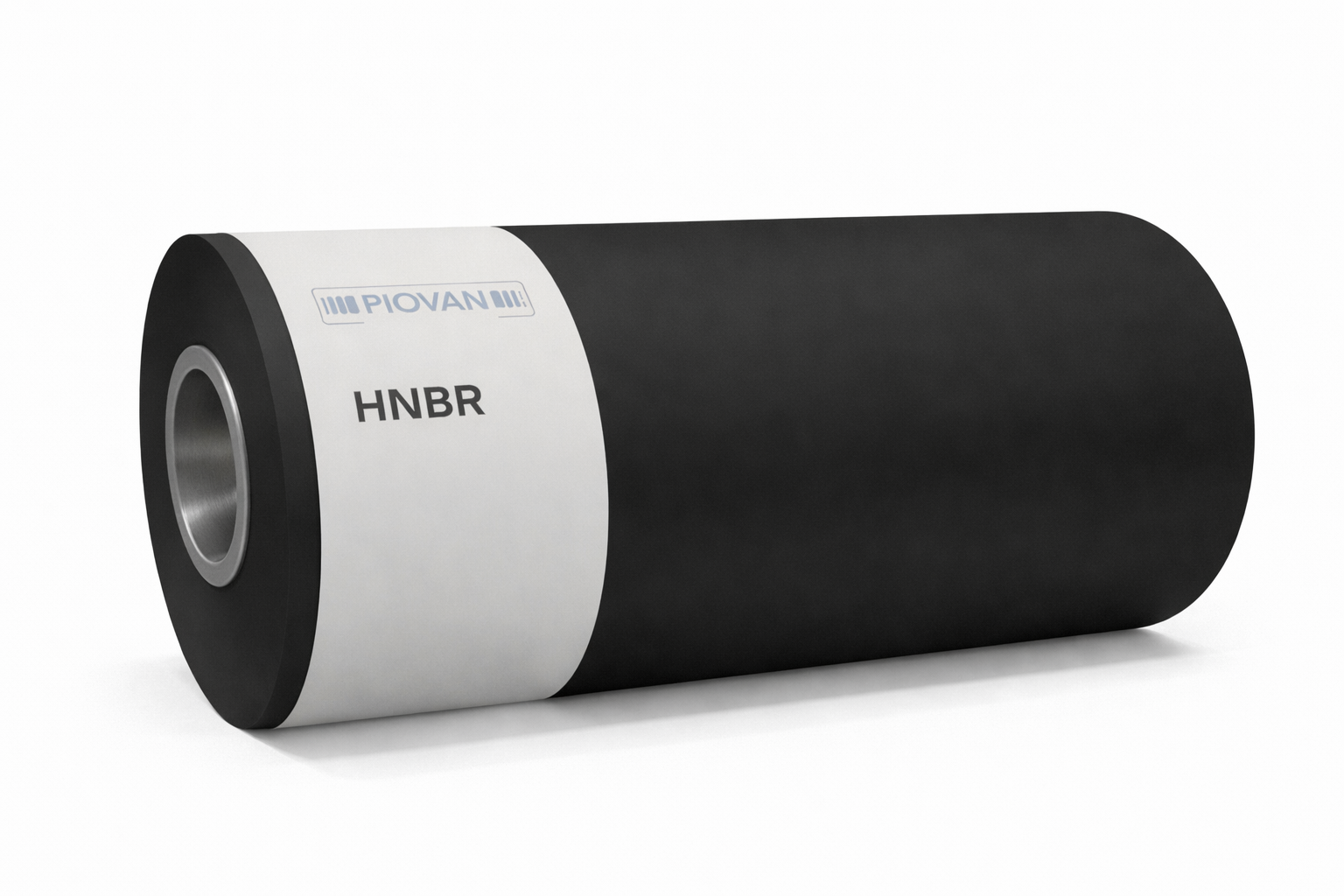
HNBR (Hydrogenated Nitrile Rubber)
If we want to highlight the distinctive features of HNBR, we can say that it is distinguished by:
- The “Sweet Spot” between performance and cost: HNBR occupies a strategic position in the elastomer market, offering superior thermal and mechanical resistance to NBR without reaching the high costs of fluoroelastomers (FKM), making it the standard for the most demanding automotive and oil & gas applications.
- Enhanced thermal and chemical resistance: Thanks to the hydrogenation process that saturates the polymer chain, this compound can operate continuously up to +150°C (with peaks of +165°C ), maintaining excellent compatibility with engine oils, hydraulic fluids and aggressive fuels where NBR would degrade rapidly.
- Excellent mechanical and dynamic properties: It is distinguished by a unique combination of very high tensile, tear and abrasion resistance, which, combined with an excellent compression set , makes it ideal for components subject to severe cyclic stress such as timing belts and deep drilling seals.
- Reliability in multi-stress environments: Unlike common nitrile rubber, HNBR has inherent resistance to weathering, ozone and oxidation comparable to EPDM, ensuring extended operating life even in the presence of external contaminants and variable environmental conditions.
General Features
The mechanical performance of HNBR places it in a higher category than most synthetic elastomers.
Working temperature: The material operates stably between -40°C and +150°C, with HT versions reaching +165°C, maintaining excellent cold flexibility for such a heat-resistant material.
Hardness range: Standard ranges from 50 to 90 Shore A, allowing for applications ranging from soft seals to rigid structural components.
Abrasion resistance: It is rated as excellent, superior to both NBR and FKM, making it ideal for dynamic seals subject to rubbing.
Tensile strength: reaches extraordinary values, typically between 20 and 35 MPa ,
Tear resistance ( 50-100 kN/m) ensures the integrity of the part even under extreme stress.
Compression set , HNBR offers very good performance (15–30% at 150°C/70h), demonstrating a higher elastic memory than NBR at high temperatures.
Its dynamic fatigue resistance is exceptional, which is why it is the material of choice for automotive timing belts.
Resistance to air and oxygen: Resistance to aging in hot air is excellent. HNBR can withstand thousands of hours at 150°C without embrittlement or significant loss of elasticity, far surpassing the performance of NBR, SBR, and natural rubber. This stability makes it perfect for modern engine compartments where operating temperatures are increasingly high.
Resistance to UV light and photooxidative agents : In terms of UV resistance, HNBR performs very well, with performance comparable to that of EPDM. It can be used in outdoor applications without suffering structural degradation or deep surface cracking, maintaining its appearance and functionality even after prolonged exposure to the sun, especially in black formulations reinforced with carbon black.
Ozone Resistance: HNBR’s ozone resistance is considered excellent. Unlike NBR, which requires protective additives, HNBR is inherently resistant to ozone attack due to its saturated molecular structure. It shows no signs of failure or cracking even in the presence of high ozone concentrations typical of industrial environments or near electrical discharges.
resistance : Resistance to aliphatic hydrocarbons (n-hexane) is excellent, with minimal swelling. It also shows good resistance to aromatic hydrocarbons (toluene, xylene), proving superior to NBR. As with all nitriles, resistance is poor to polar solvents (acetone, MEK) and chlorinated solvents, which cause the material to swell significantly.
Resistance to oil, fuels, and hydrocarbons: HNBR excels in contact with mineral oils, hydraulic oils, and lubricating greases, even when mixed with aggressive additives such as amines (common in modern oils). Resistance to diesel fuels and gasoline is excellent. It is also particularly resistant to ” sour ” oils (containing H2S) typical of the oil and gas sector, where other elastomers would fail due to chemical embrittlement.
Resistance to water and other chemicals: Unlike polyurethane or NBR, HNBR offers excellent resistance to hot water and steam up to 150°C, as it is not subject to hydrolysis. It also has good resistance to diluted acids and bases, refrigerants (R134a), and water-glycol mixtures used in cooling systems. It also offers superior resistance to oxidized fuels ( sour gases) and automatic transmission fluids (ATF).
Want to learn more about other tires? Click here.
You might be interested
Request a quotation
id prod->8281
nome prod->HNBR (Hydrogenated Nitrile Rubber)
id prod->8281
nome prod->HNBR (Hydrogenated Nitrile Rubber)