
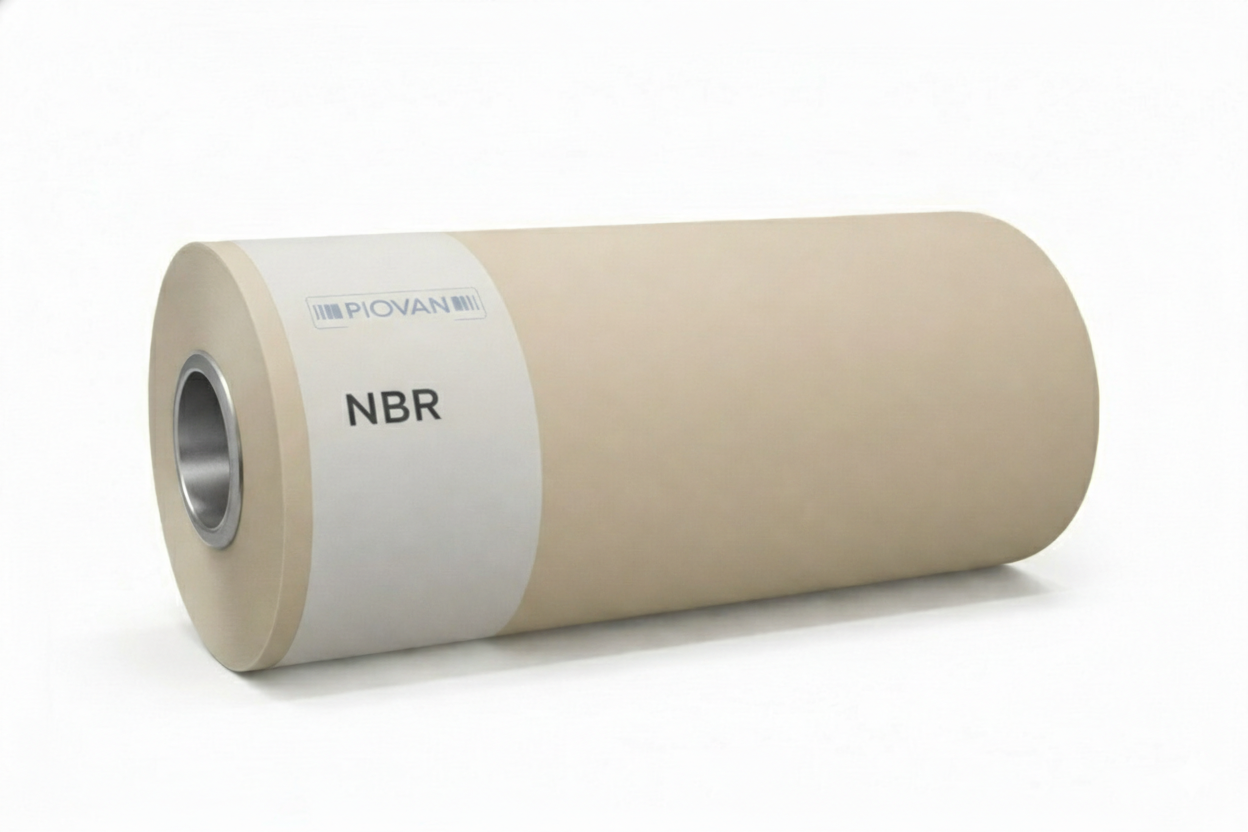
NBR (Nitrile Butadiene Rubber)
If we want to summarise the distinctive features of NBR we can consider:
- Unrivaled Oil Resistance: NBR is the absolute benchmark material for sealing in oily environments, offering excellent resistance to mineral oils, diesel fuels and aliphatic hydrocarbons with minimal swelling.
- Unbeatable performance/cost ratio: It represents the most used elastomer worldwide thanks to its ability to guarantee durability and sealing in aggressive environments at extremely competitive costs compared to other materials.
- Mechanical versatility and adjustable hardness: It is characterized by a wide hardness range (from 30 to 90 Shore A) and superior abrasion resistance, making it ideal for dynamic applications subject to cyclic stress and rubbing.
- Customizable Properties via ACN: Its chemical structure allows for precise modulation of the acrylonitrile (ACN) content to perfectly balance chemical resistance to oils with the flexibility needed at low temperatures.
General Features
The mechanical performance of NBR is closely related to its formulation and acrylonitrile content.
Operating temperature: The material generally operates between -40°C and +120°C, with peaks up to +140°C; a high ACN content tends to limit low-temperature performance, while variants such as HT-NBR extend the upper limit.
Hardness range: it is extremely flexible, ranging from 30 to 90 Shore A thanks to the modulation of fillers and vulcanizing agents.
Abrasion resistance: It is classified as excellent (ASTM D2228), being superior to most standard elastomers, especially when optimized with carbon black.
Tensile strength: Typically ranges between 7 and 25 MPa , depending on hardness and vulcanization system.
Compression set : the material offers good to moderate values (20–40% at 70°C/22h), with significant improvements in peroxide-based formulations.
Low-temperature flexibility ranges from moderate to good: a low ACN content favors cold-weather flexibility, while a high content favors oil resistance. In high-cycle, dynamic applications, it is recommended to verify fatigue behavior since geometry and reinforcement significantly influence service life.
Weather Resistance: NBR has residual double bonds in the backbone chain that make it inherently vulnerable to oxidative and photooxidative attack , requiring careful analysis for outdoor applications.
Air/Oxygen Resistance: Resistance to aging in air at room temperature is considered good due to the antioxidants present in standard formulations. However, at high temperatures (above 80°C), oxidation accelerates significantly, requiring the use of highly efficient antioxidants such as p-PPD or TMQ. Resistance is poor in the presence of pure oxygen or high pressures, where degradation occurs rapidly.
Resistance to light (UV) and photooxidative agents : Direct exposure to solar UV rays causes embrittlement and surface cracking due to the elastomer’s low natural resistance. This resistance becomes moderate in the presence of carbon black, which acts as a protective screen. In indoor environments with only fluorescent lighting, however, performance is considered good for most applications.
resistance : Ozone resistance is a critical issue: even at minimal environmental concentrations (0.01–0.05 ppm), NBR exhibits poor resistance, developing cracks under mechanical stress. At industrial concentrations above 0.1 ppm, the material should be avoided at all costs due to the risk of premature failure. The addition of waxes and ozone-reducing additives (p-PPD) offers only moderate protection, not comparable to materials such as EPDM or CR. For highly ozonized environments, the use of NBR/PVC blends or switching to more resistant elastomers is recommended.
Chemical Resistance : Chemical resistance is the real strength of NBR, with performance varying according to the ACN content: a medium-high level (33–41%) guarantees optimal protection, although it sacrifices some flexibility when cold.
Solvent Resistance: Solvent resistance is extremely diverse. Resistance is excellent to aliphatic hydrocarbons (n-hexane, heptane), with minimal swelling. Conversely, resistance is poor to aromatic hydrocarbons (toluene, xylene), chlorinated solvents (DCM, TCE), and polar solvents such as ketones and esters (MEK, acetone), which cause severe swelling of the material. Resistance to alcohols (methanol, isopropanol) is considered moderate and must be verified based on temperature and concentration.
Resistance to petroleum, fuels, and hydrocarbons: NBR is the absolute benchmark for mineral oils and mineral hydraulic oils, ensuring minimal swelling and long life. Resistance is also excellent for diesel fuels and good for standard gasoline, although high ACN formulations are recommended for aromatics above 30%. Resistance to biofuels (E85, B100) is moderate due to the oxygenated components that increase swelling. Finally, it shows good resistance to vegetable oils, animal fats, and liquefied natural gas (LNG).
Resistance to water and other chemicals: NBR resists water excellently at room temperature, but its resistance drops (from moderate to poor) to hot water or steam above 80°C due to hydrolysis. Resistance is good to dilute bases and saline solutions, but only moderate to dilute acids and refrigerants (R134a, R1234yf). Use with concentrated acids is not recommended. For detergents, compatibility depends on the nature of the surfactants: good for anionic ones, less so for cationic ones.
Want to learn more about other tires? Click here.
You might be interested
Request a quotation
id prod->8111
nome prod->NBR (Nitrile Butadiene Rubber)
id prod->8111
nome prod->NBR (Nitrile Butadiene Rubber)