
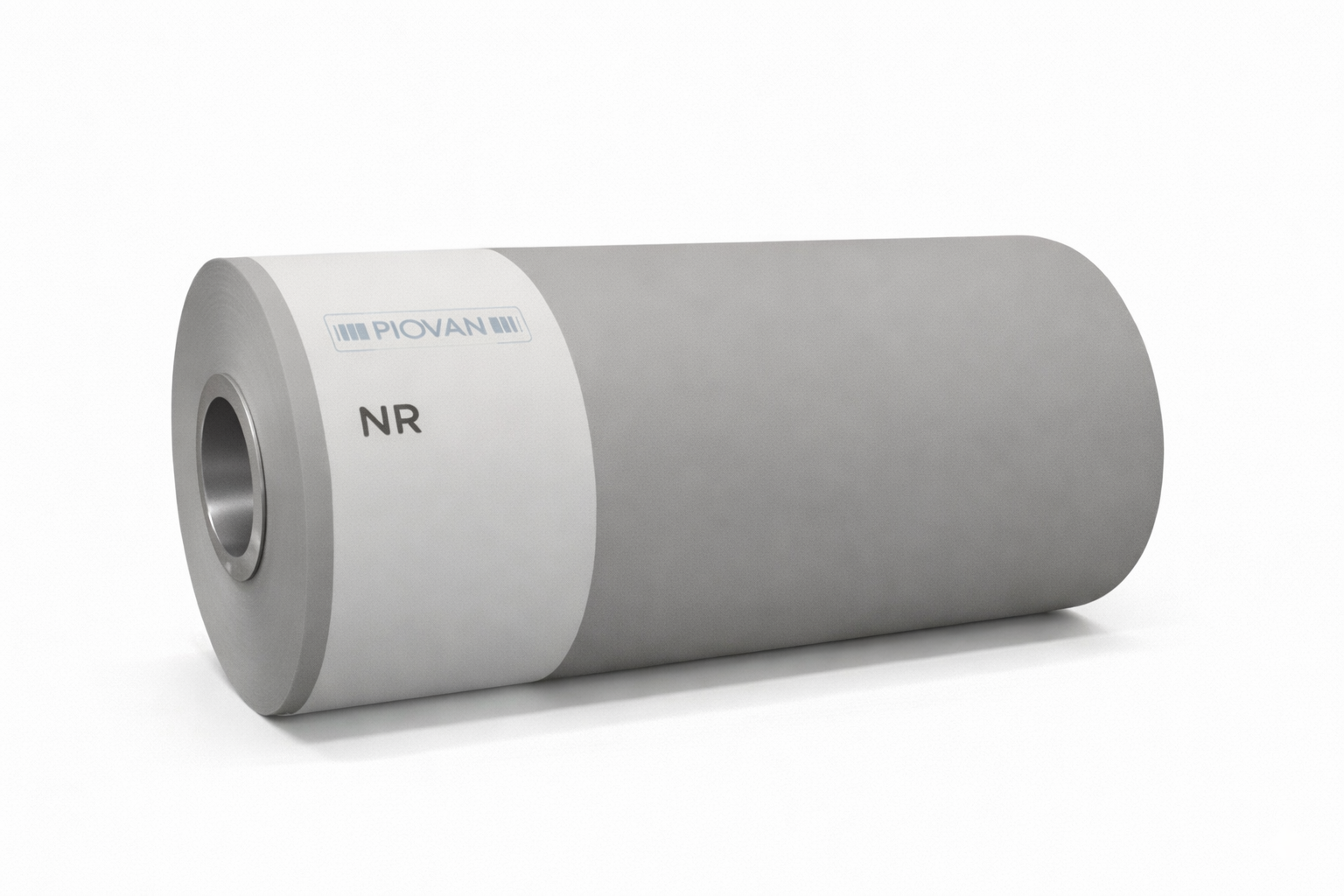
NR (Natural Rubber)
The distinctive characteristics of Natural Rubber (NR) and its unsurpassed value in the panorama of elastomers are:
- The absolute benchmark for resilience: Natural rubber still holds the record for rebound elasticity (over 80%), offering a springback capacity and dynamic response that no synthetic elastomer has managed to match in almost two centuries.
- Unbeatable resistance to fatigue and internal heat: Thanks to its perfect molecular structure, NR is the only material capable of withstanding continuous high-frequency deformation cycles while minimising internal heat build – up , a feature that makes it irreplaceable for aircraft tyres and heavy transport giants.
- Superior Mechanical Toughness: This material is distinguished by exceptional tear and cut resistance, maintaining structural integrity even under conditions of extreme mechanical stress where other materials would quickly crumble.
- Nature’s excellence in the technical world: Despite the progress of polymer chemistry, natural rubber remains the dominant component (over 90%) in anti-vibration systems and silent blocks. high-quality blocks , confirming that for pure mechanical performance, nature’s “formula” remains the most reliable technical solution.
General Features
The mechanical performance of natural rubber is closely related to the purity of the grade used (such as SMR or RSS) and the vulcanization system.
Working temperature : The material excels at low temperatures, operating between -60°C and +80°C, with temporary peaks up to +100°C. Beyond this threshold, the material tends to degrade by reversion.
The hardness range is extremely wide, ranging from 30 to 90 Shore A.
strength : it is exceptional, reaching values between 20 and 30 MPa , higher than almost all synthetics.
Tear resistance: extraordinary (80-120 kN/m) and allows the material not to propagate cuts or incisions under load.
Compression set: NR offers good values (20–35% at 70°C/22h), although it tends to worsen compared to specific synthetics in case of prolonged exposure to heat.
Flexural fatigue strength: This is considered the absolute industry benchmark for component durability subjected to millions of cycles.
Resistance to air and oxygen: When aged in air at room temperature, NR exhibits moderate resistance; without antioxidants, it tends to harden or become sticky over time. At high temperatures (>80°C), resistance becomes poor as oxidation accelerates rapidly, causing the elastic properties to deteriorate.
Resistance to light (UV) and photooxidative agents : Direct exposure to solar UV rays is critical and causes rapid surface degradation ( crazing ). Resistance is considered poor if the material is unprotected, but can be achieved moderate or good through the addition of high percentages of carbon black and UV absorbers.
Ozone resistance: Ozone resistance is one of natural rubber’s weakest points. Even at minimal ambient concentrations, the material develops deep cracks under mechanical stress. The use of migratory waxes and chemical ozone inhibitors (p-PPD) is mandatory to improve resistance to acceptable levels, but for high ozone concentration environments, it is not recommended compared to saturated polymers like EPDM.
Solvent Resistance: Resistance to aliphatic and aromatic hydrocarbons (hexane, toluene) is poor, with severe swelling leading to loss of component integrity. The same is true for chlorinated solvents. Conversely, it exhibits good resistance to polar solvents such as acetone and excellent resistance to alcohols (methanol, ethanol), making it suitable for these specific substances.
Resistance to petroleum, fuels, and hydrocarbons: The use of natural rubber in contact with mineral oils, diesel fuels, and gasoline is strongly discouraged due to its poor resistance and rapid degradation. Resistance to vegetable oils and animal fats is also limited (moderate to poor), so NBR is preferred in these cases.
Resistance to water and other chemicals: NR offers excellent performance with water at room temperature and good resistance to hot water up to 70-80°C. It is widely used with dilute acids and bases, where it exhibits good to excellent resistance, and with saline solutions. However, it is not suitable for concentrated acids or high-temperature steam. It is very compatible with glycols used in cooling systems.
Want to learn more about other tires? Click here.
You might be interested
Request a quotation
id prod->8230
nome prod->NR (Natural Rubber)
id prod->8230
nome prod->NR (Natural Rubber)