
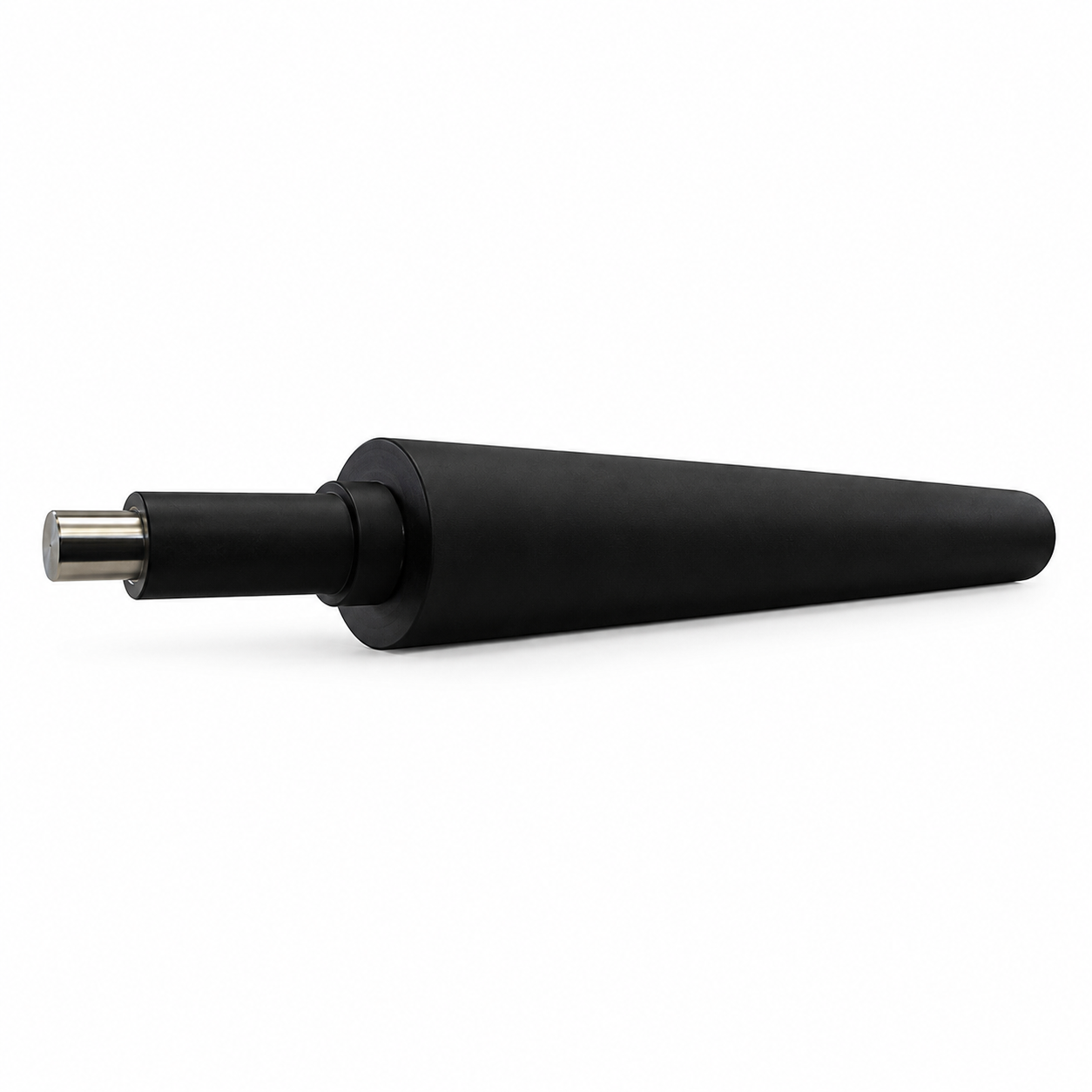
Rubber-coated squeeze rollers for textile dyeing padders
Rubber-coated padder rollers (also called squeezing rollers ) are critical components in continuous impregnation textile dyeing and finishing machines. They operate in pairs, typically an upper and lower roller, both rubber-coated or a combination of rubber and metal, exerting controlled pressure on the impregnated fabric to precisely regulate the pick-up (liquid absorption rate expressed as a percentage of the dry fabric weight).
The target pick-up in dyeing processes with reactive, direct or disperse dyes is typically between 60% and 100% WPU (Wet Pick-Up) , while in functional finishing processes (water repellency, flame retardancy, antimicrobial) it can be reduced to optimize the chemical yield.
The fabric passes through the tank, absorbs the treatment bath, then is squeezed by the cylinders to:
- to evenly distribute the dye or chemical auxiliary across the entire width of the fabric (cross- direction uniformity );
- precisely control the quantity of liquid retained in the fabric before the subsequent phases (vaporization, polymerization, drying);
- reduce the consumption of water, energy and chemicals.
The quality of the rubber coating of the cylinder is therefore crucial for the repeatability of the process and the dyeing quality of the finished product .
Technical specifications of A.Piovan padder coverings
A.Piovan produces complete rubberized cylinders, the result of decades of experience in the textile industry. The main technical features are:
- Hardness: Available from 70 ShA up to Ebonite (Shore D, ~100 ShA equivalent), selectable based on the type of process. Lower hardnesses (70–75 ShA) offer greater elastic deformation and more uniform pressure distribution on delicate fabrics; higher hardnesses (85–95 ShA ) guarantee greater resistance to permanent deformation at high working pressures.
- Working pressure: Industrial padders operate at linear pressures between 20 and 80 N/mm, sometimes higher in high-pressure padders for pad -batch or pad-steam processes . The coating must maintain its cylindrical geometry without ovalization or abnormal curvature.
- Chemical resistance: Blends are formulated to resist the main chemicals used in textile processing—reactive dyes in alkaline environments (pH 10–12), acid dyes, dispersed in high-temperature baths, ionic and non-ionic auxiliaries, reducing agents (such as sodium hydrosulphite in indigo dyeing), organic and peracetic acids used in finishing. A.Piovan has developed different types of coatings depending on the chemical specifications of the baths.
- Thermal resistance: Continuous dyeing processes involve working temperatures of up to 60–95°C; A.Piovan coatings are formulated to maintain dimensional and mechanical stability under these operating conditions.
- Rubber-to-metal adhesion: The bond between the elastomeric liner and the metal core is ensured by vulcanization processes with high-tenacity primers, to prevent delamination under cyclic dynamic loading—a major cause of failure in highly used squeezing rolls. The heads and ends are rubberized to increase protection for the metal roll.
- Surface profile: the surface of the covering can be straight (for flat, uniform fabrics) or curved (crown profile) to compensate for the deflection of the cylinder under load and ensure uniform pressure across the entire working width, which in industrial padders can exceed 3,000 mm.
Which compounds should you choose based on the application?
A.Piovan ‘s technical contact will be able to advise you appropriately based on your application (dyeing with alkaline or dispersed reactive dyes at high temperatures, finishing, pad -batch)
The metal cylinder can be supplied based on the customer’s design or made directly by A.Piovan , guaranteeing the correct geometric tolerance ( runout ≤ 0.05 mm) necessary for homogeneous squeezing .
Why rubber roller quality affects fabric quality
A non-uniform or degraded rubber roller introduces dyeing defects that are difficult to correct in subsequent processing stages:
- Streaking (longitudinal stripes): caused by non-uniform wear or surface scoring of the covering, creating differential pressure zones.
- Listing (selvedge-to-centre colour variation): a consequence of incorrect crown profile or permanent set of the covering.
- Pick-up variation: every ±5% variation in WPU translates into a visually perceptible difference in colour depth (ΔE > 0.5 CIE Lab).
Periodic replacement of the covering — or surface grinding in the case of rebuildable rollers — is an integral part of the preventive maintenance programme in a high-efficiency continuous dyeing department.
You might be interested
Request a quotation
id prod->8590
nome prod->Rubber-coated squeeze rollers for textile dyeing padders
id prod->8590
nome prod->Rubber-coated squeeze rollers for textile dyeing padders