
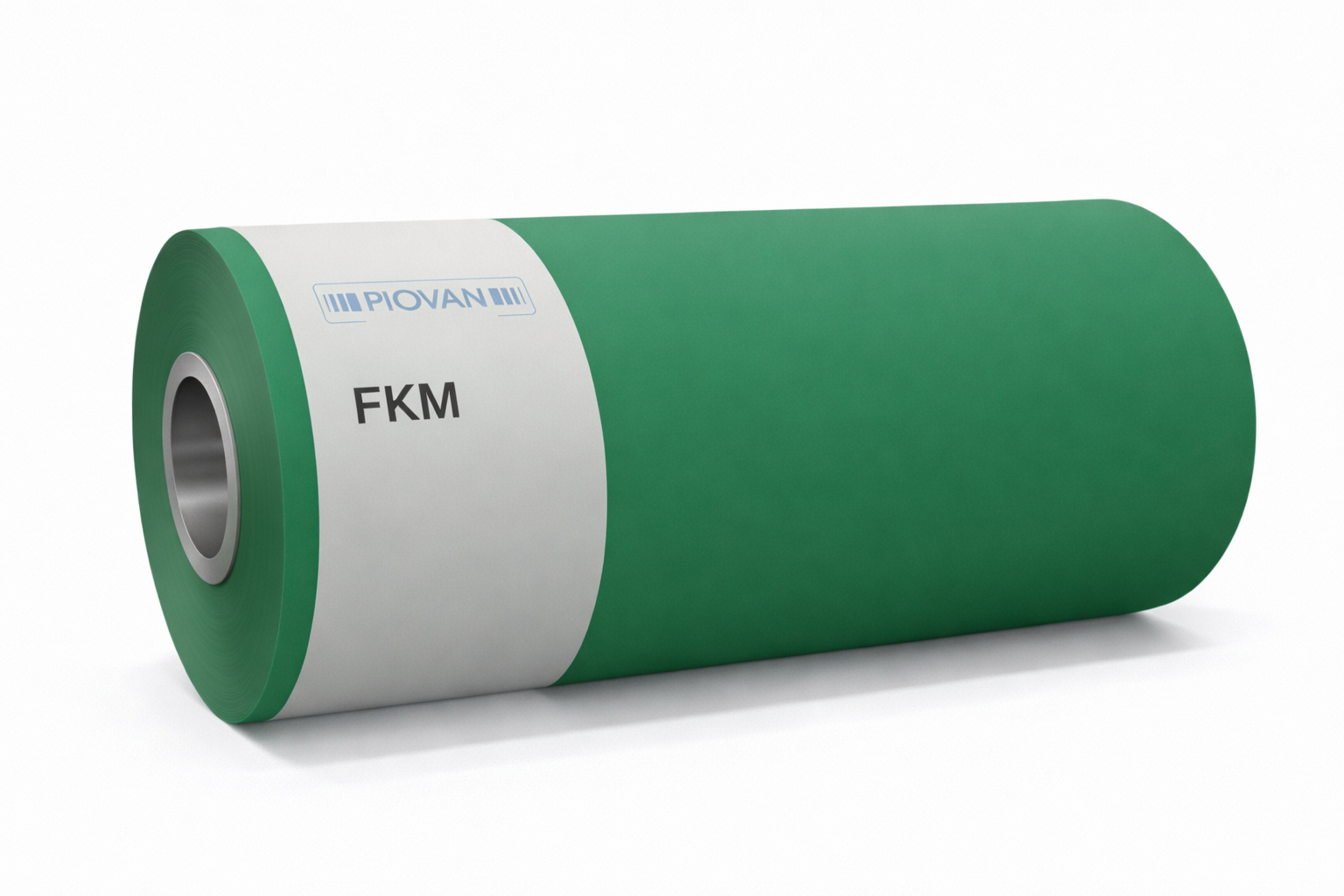
FKM (Fluoroelastomer — Viton®)
If we want to summarise the distinctive characteristics of the FKM compound, highlighting its technical and applicative value:
- Unrivaled thermal and chemical resistance: FKM represents the gold standard for critical applications, ensuring continuous operation up to +200°C (with peaks of +250°C ) and almost total inertia towards synthetic oils, aggressive fuels, concentrated acids and aromatic solvents.
- Structural reliability and superior sealing: Thanks to an excellent compression set even at high temperatures, this compound ensures a prolonged static and dynamic seal over time, maintaining mechanical integrity where standard elastomers such as NBR or EPDM would quickly fail.
- Extreme durability in harsh environments: Its fully fluorinated structure provides intrinsic immunity to ozone, UV rays and oxidation, allowing for an outdoor service life of more than 30 years and absolute performance in high vacuum conditions or exposure to radiation.
- Cost-effectiveness based on TCO: Although the initial cost is higher, FKM proves to be the most advantageous investment thanks to a useful life 10-50 times longer than common compounds, drastically reducing plant downtime, maintenance and the risk of catastrophic failures.
General Features
The mechanical performance of FKM is exceptional, especially when evaluated under thermal stress conditions where other materials decay.
Working temperature : , the material operates stably between -20°C and +200°C, with special grades that can drop to -40°C or rise to temporary peaks of +250°C.
Hardness range: Standard is 60 to 90 Shore A, providing the stiffness needed to withstand extrusion in high pressure applications
Abrasion resistance: it is classified from good to excellent, ensuring durability even in environments with the presence of particulate matter
Tensile strength: it is high (10–20 MPa ),
Compression set: FKM offers exceptional values (10–20% at 200°C/70h), maintaining elastic memory and sealing capacity even after years of compression at high temperatures
Resilience: It is moderate at room temperature but improves significantly when warm.
Flame resistance: superior intrinsic resistance , being self-extinguishing and characterised by very low smoke emission in the event of combustion.
Resistance to air and oxygen: Aging in air is considered exceptional. Even at temperatures of 200°C for thousands of hours, FKM retains its elastic and mechanical properties almost unchanged, whereas standard organic elastomers would char or become brittle.
Resistance to light (UV) and photooxidative agents : Resistance to UV rays and direct sunlight is complete (exceptional). The material shows no signs of degradation, embrittlement, or significant color change even after decades of outdoor exposure. This stability makes it ideal for outdoor aerospace applications or components exposed to intense solar radiation.
Ozone resistance: Ozone resistance is classified as absolute. Even at high concentrations and in the presence of mechanical stress, FKM does not develop any cracks. It is the reference material for gaskets near high-voltage sources or in environments where ozone is used as an industrial oxidizing agent.
Solvent resistance: Its behavior towards aliphatic, aromatic, and chlorinated hydrocarbons is excellent, with minimal swelling even at high temperatures. However, FKM has specific limitations: it has poor resistance to polar solvents (such as acetone and MEK) and to some esters and amines, for which the use of EPDM or specialty FKM (FFKM) grades is recommended.
Resistance to oil, fuels, and hydrocarbons: FKM is unrivaled in this area: its resistance to mineral oils, high-temperature synthetic oils, gasoline (even containing alcohol), and diesel/jet fuel is exceptional. It is the only material capable of ensuring a reliable seal in modern injection systems and turbines, where the combination of heat and fuel chemistry would quickly destroy NBR or neoprene seals.
Resistance to water and other chemicals: FKM offers excellent resistance to concentrated strong acids (sulfuric, nitric, hydrochloric) and most oxidizing chemical solutions. Resistance to water and steam is good, but for prolonged exposure above 150°C, peroxide-cured grades should be selected to avoid hydrolysis. It is also compatible with the latest generation of coolants and most fire-resistant hydraulic fluids.
Want to learn more about other tires? Click here.
You might be interested
Request a quotation
id prod->8264
nome prod->FKM (Fluoroelastomer — Viton®)
id prod->8264
nome prod->FKM (Fluoroelastomer — Viton®)