
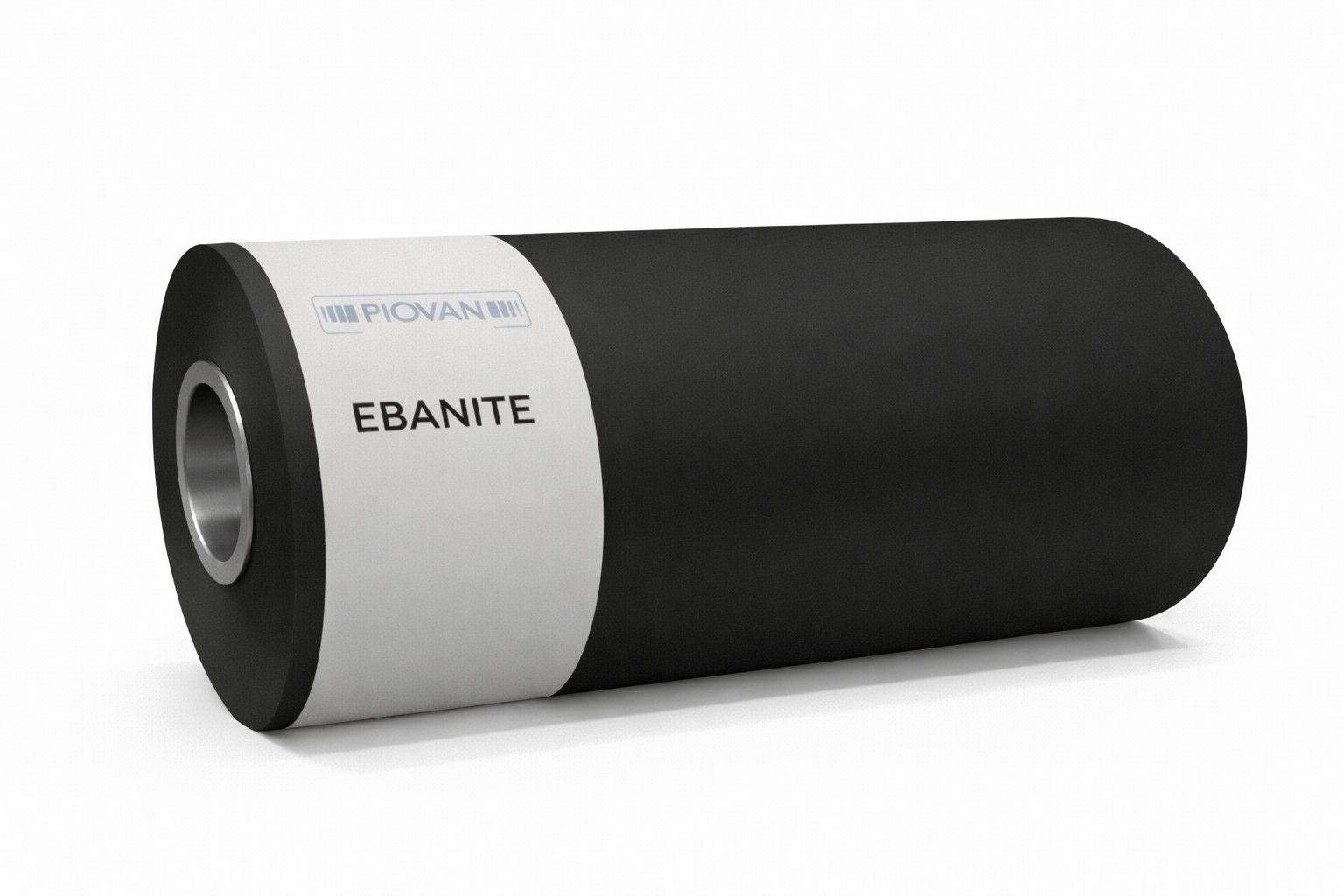
EBONITE (Vulcanized Hard Rubber)
Ebonite is a standalone solution for specific industrial rolling applications, as it is:
- A rigid liner that surpasses the limitations of conventional elastomers: Its extreme vulcanization process transforms natural rubber into a rigid and thermo-rigid material with a consistency similar to engineering plastics. This makes it the ideal choice for rolls that must exert precise and uniform contact pressures without liner failure, in high-definition rolling, printing, or calendering applications.
- Integrated electrical insulation for rolls in high-risk environments: Thanks to its extremely high volumetric resistivity and stable dielectric properties even in the presence of humidity, ebonite ensures reliable and long-lasting insulation in industries where charge-sensitive materials are processed.
- Dimensional accuracy and chemical resistance for high-specification rolls: Ebonite can be machined to tight dimensional tolerances, ensuring precise geometries and a consistent, glossy black surface finish. Its exceptional resistance to diluted acids also makes it suitable for cylinders used in chemical, galvanic, or surface treatment processes, where the integrity of the coating in contact with aggressive solutions is crucial to the quality of the final product.
- The technical choice for high-demand industrial niches: ebonite plays an irreplaceable role in segments where no other coating offers the same combination of controlled rigidity, chemical inertness, and precision machinability. Where the dimensional stability of the coating is critical to the process, ebonite remains the gold standard for those who cannot afford to compromise.
General Features
The performance of ebonite differs significantly from that of common rubbers, approaching that of rigid plastic materials but with greater fragility.
Working temperature , the material maintains its rigidity up to approximately +70 °C or +80 °C; beyond the glass transition temperature (Tg), ebonite tends to soften, losing its dimensional accuracy.
The hardness range is very high, typically between 70 and 85 Shore D, making it suitable for precision machining such as thread cutting and drilling.
Abrasion resistance is considered good, although the material is more prone to scratching than polyurethanes due to its rigid nature.
Tensile strength varies between 50 and 70 MPa , remarkable values for a rubber derivative,
elongation at break (usually <5%), which highlights its fragility in the face of impacts.
Compression set is not an applicable parameter in the elastomeric sense, since the material is rigid and does not recover significant elastic deformations.
dimensional stability at room temperature, outperforming many creep- prone thermoplastics .
Resistance to air and oxygen: Resistance to aging in air is very good. The densely cross-linked structure limits oxygen penetration, preventing internal degradation. However, prolonged thermal aging above 80°C may cause further embrittlement or slight distortion of the component’s geometry.
Resistance to UV light and photooxidative agents : Resistance to UV rays is one of the key aspects of this material. Although structurally stable, prolonged exposure to sunlight causes a surface chemical reaction (oxidation of free sulfur) that leads to the formation of a dull, greenish-gray patina. This phenomenon, purely aesthetic and removable with polishing, can, however, alter the surface’s insulating properties over time if left unchecked.
Ozone resistance: Ebonite has excellent ozone resistance. Unlike soft rubber, it is not subject to ozone cracking because the polymer chains are so tightly bound and rigid that they prevent crack propagation. It is therefore an extremely reliable material in environments with high ozone concentrations or near electrical discharges.
Solvent Resistance: Solvent resistance is generally good: it resists aliphatic hydrocarbons and many common solvents well. However, resistance to aromatic hydrocarbons and chlorinated solvents is only moderate, which can cause surface softening. Compatibility with alcohols is excellent, making it suitable for various historical laboratory applications.
Resistance to oil, fuels, and hydrocarbons: Ebonite exhibits surprising resistance to mineral oils and fuels, far superior to soft natural rubber. Although it is not the primary material for these applications in modern industry, its inertness to lubricants and greases is considered very good.
Resistance to water and other chemicals: Ebonite is renowned for its resistance to dilute acids (such as battery sulfuric acid) and bases. It is virtually inert to water and humidity, does not swell, and maintains its dielectric properties even when immersed. Resistance to concentrated acids, however, is limited. Thanks to these qualities, it has been the standard for decades in the construction of battery cases and tanks for the electroplating industry.
Want to learn more about other tires? Click here.
Would you download the document?
You might be interested
Request a quotation
id prod->8287
nome prod->EBONITE (Vulcanized Hard Rubber)
id prod->8287
nome prod->EBONITE (Vulcanized Hard Rubber)